TOP 10 SERVICES INCLUDED IN A BRANDING PACKAGE. WHO NEEDS THEM?

#1 LOGO DESIGN

Logo and brand design are tightly intertwined since any logo is an inherent part of visual brand identity. Besides, a complete branding package almost always offers logo creation as one of its primary services.

Logo design is a perfect way to make your company noticeable among its competitors and lay the foundation for your future marketing success. Since its first days, a logo will build a strong association with your company and services. Hence, make sure to invest in its quality and design. Also, note that there are different types of logos to choose from.

You’ll have to design the most suitable option for your case. Regardless of whether you order a complete branding package or a separate item, a logo is a must. Ideally, the logo design should be created before both large or small business is launched.logo design for SF catering company01logo design for SF catering company
#2 COLOR PALETTE

If you are just launching a company or still haven’t selected your brand colors, ask to add this option to your branding kit. A color palette has a significant influence on your brand image and perception.

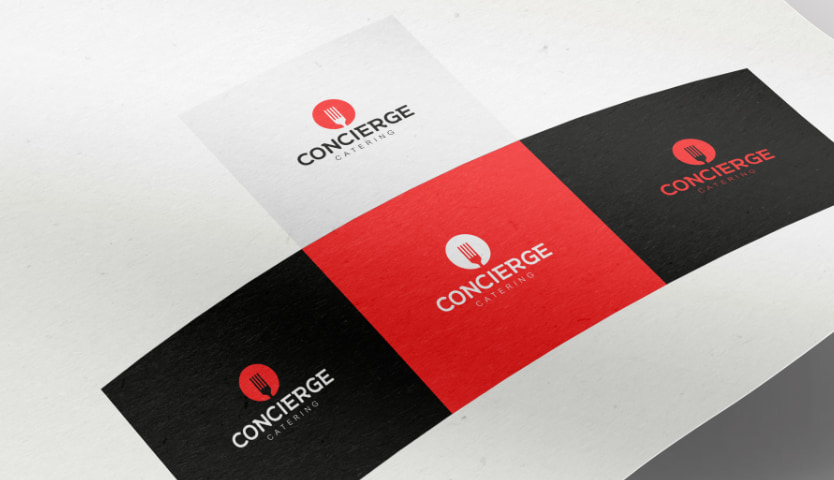
Moreover, this branding package service is necessary for any company interested in long-term development and high-quality marketing. Note that color selection is a crucial visual branding step, so make sure to entrust it to professionals.Color Palette02Color Palette
#3 EMAIL TEMPLATES

Nowadays, a huge number of business operations happen online. Hence, it’s almost impossible to keep the leading market position if you don’t use emails as one of your marketing channels.

This is especially true for those engaged in e-commerce. A branding kit of every online store would be incomplete without branded email templates.

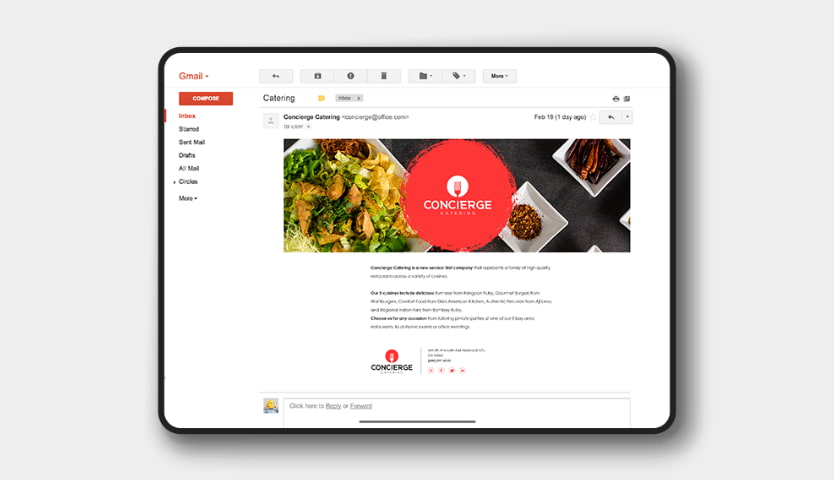
They turn your newsletters into a more powerful promotional tool and encourage recipients to take action. Therefore, don’t hesitate to use this branding package option if you send a lot of B2C or B2B emails and need to brand them.A branding kit of every online store would be incomplete without branded email templates03A branding kit of every online store would be incomplete without branded email templates
#4 WEBSITE

We know that websites aren’t the first thing associated with business branding packages. However, if you’re lucky to find a professional design agency, it may offer you website design as a branding kit option.

Moreover, it’s nice to have some branding elements on your official web page to promote your brand online. Even the most popular offline leaders need to work on their online presence to expand their target audience and promote their products. Thus, a stylish, convenient, and informative website is something any company cannot live without.

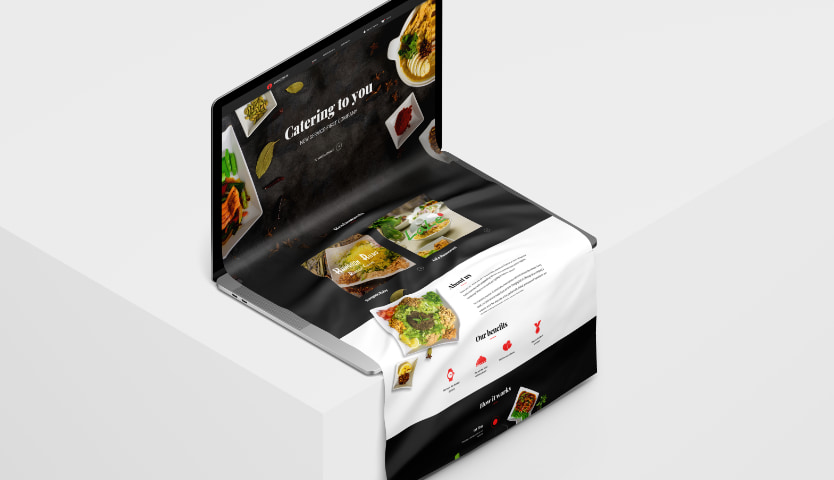
Check out a food provider’s website designed by The Coder to see how it combines several branding elements and promotes the services.Concept of website design04Concept of website design
#5 TYPOGRAPHY

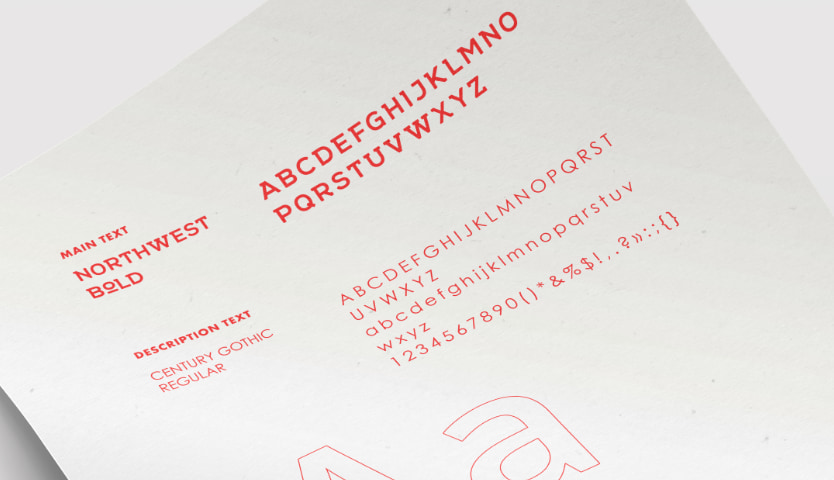
Let’s be honest, typography isn’t the most popular branding element, and many companies choose to ignore it. In most cases, they believe that font selection is easy and doesn’t require careful reasoning.

Only professionals know the power of typography and its impact on the overall perception of branding. Therefore, a full branding package includes typography as its key element supplementing others.

Unlike a large enterprise, a small business can do without customized fonts. Especially, if it doesn’t use a lot of titles or text content. Yet for seamless multifaceted branding experience, it’s better to design customized fonts.Typography one of the most branding element05Typography one of the most branding element
#6 LETTERHEAD

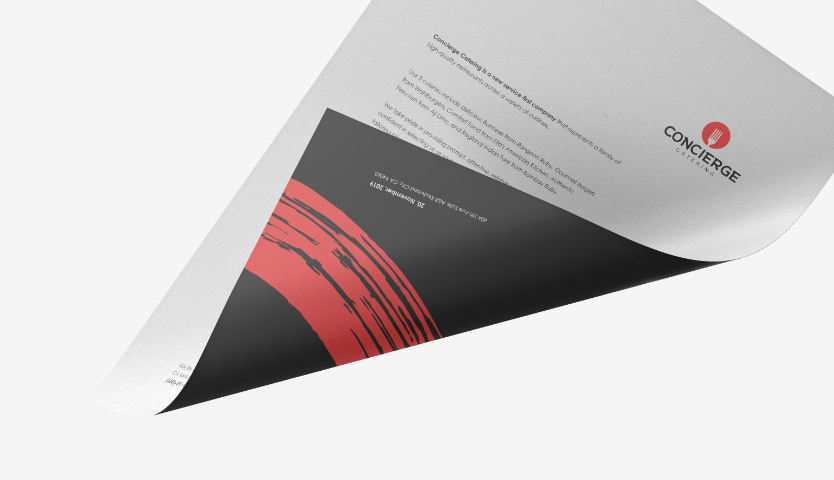
If you send a lot of email attachments or use direct mail marketing, make sure to design a customized letterhead. This package branding element will make your message more memorable and increase response rates.

It usually includes the name and address of a company placed on its brand colors at the top of the page. Creating a letterhead, it’s important to stick to your brand style and use the right proportions of the heading and blank space.Letterhead design for SF catering company06Letterhead design for SF catering company
#7 BROCHURES

Brochures aren’t included in all branding packages for an obvious reason. Therefore, if you want to start a direct mail campaign or distribute printed marketing materials through any other channels, discuss this directly with your design agency.

Most brochures contain the logo, slogan, services, advantages, and contact information of a company. This is a perfect mix that covers the informational needs of an average target audience. Professional designers will help you create a brochure that catches attention and presents your brand in the most appealing way. Also, this method is usually favored by a medium or small business that operates locally and bets on offline marketing.Mask Group 18807Mask Group 188
#8 BUSINESS CARDS

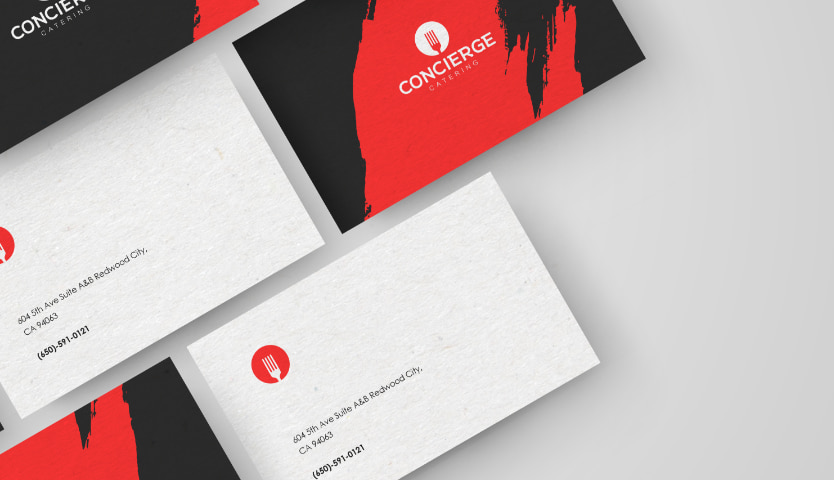
Most corporate identity packages offer business cards. Easy to design and cheap to print they play an important role in your visual brand identity. If you hire many people and need a similar business card design, the agency will provide you with a customizable template.

Your company size and type of services have absolutely no impact on the necessity to use business cards. Everyone should be able to easily share their contact information. So it’s better to order business card design along with other branding items.Business cards design for SF catering company08Business cards design for SF catering company
#9 PACKAGE DESIGN

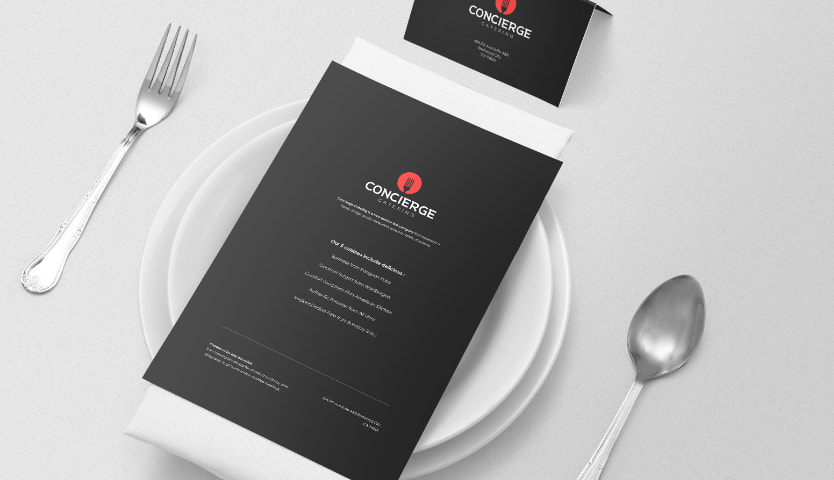
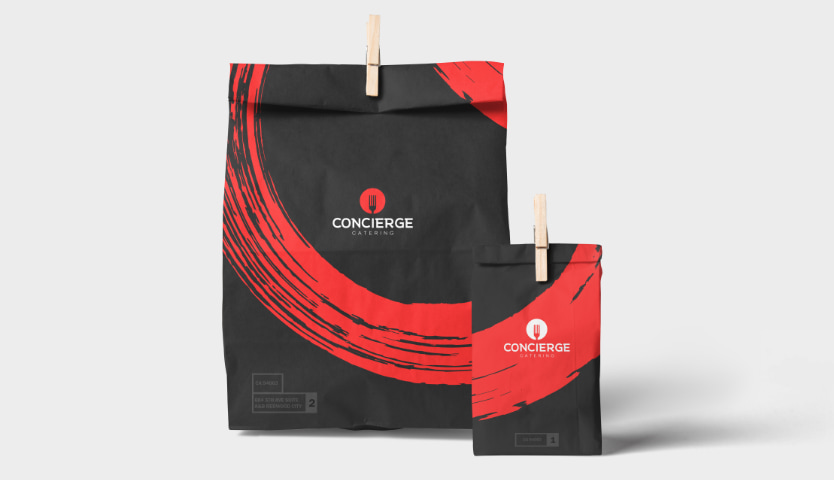
In some cases, a branding package heavily depends on a product package (Sounds pretty complicated, right?) Let’s clarify what we mean here. Package design is the look of all products that end consumers see in a shop or an online store. Want an example? The Coder has created branding that includes package design, for Concierge Catering. Click here to check out the final result.

Packages have a strong influence on the decision-making process. Furthermore, people often buy something only because they like its look. Thus, if you are a company that produces any mass-market product, you’d better entrust your product package to professionals. This will be a wise investment in the development of your company and a great way to stand among your competitors.Packaging design for SF catering company09Packaging design for SF catering company
#10 STYLE GUIDES

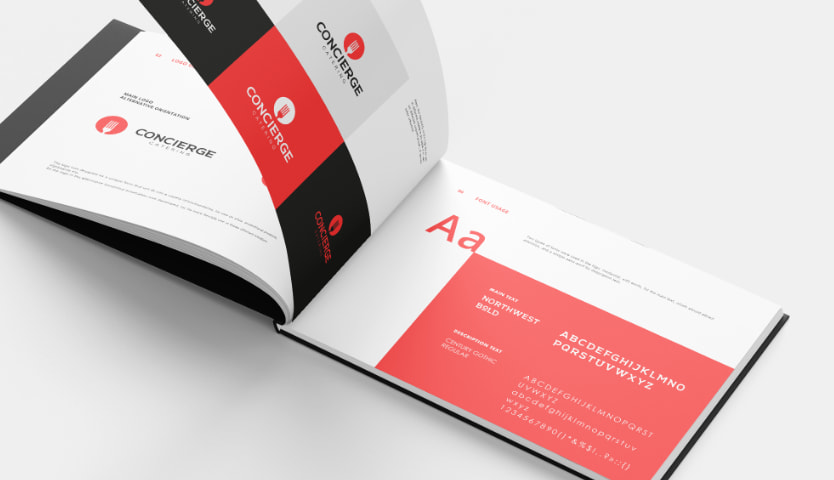
A style guide is a comprehensive rulebook with all specifications related to your brand. In particular, it will include your mission, vision, core values, company voice, logo, typography, and principles.

Style guides will come in handy to marketers, graphic designersweb developerssales team, and anyone who needs to present a unified vision of your brand to your target audience.

This type of branding package is most suitable for large market players willing to build a far-reaching marketing strategy.

The listed items aren’t neither canonical nor exclusive. Besides, they don’t necessarily have to be included in every branding package. This is a basis you can rely on to understand what visual branding can boost your marketing campaign. In some cases, it’s even better to refuse from a branding package in favor of separate branded items.

If you hire a design agency that is flexible and open for communication, there should be no problems with that. You will be able to select the required branding elements and find the optimum solution for your project.

The Coder covers all these branding package elements and even more. Contact us to discuss branding package prices for your business.A style quide is a comprehensive rulebook with all specifications related to your brand10A style guide is a comprehensive rulebook with all specifications related to your brand
Successful Site in 12 Months with Google Alone

26 Steps to 15k a Day – A Modern Guide to Content Marketing

In another post Google as a Black Box  Giacomo proposed that we talk too much theory and not enough application of it. So, lets skip the theory and get to what I know works from time proven methods on Google. I know the following system works 100% of the time with Google to attain rankings across a wide range of keywords. This is what I do with clients to build a successful site and has worked every time. The level of success will depend largely on the subject matter, it’s potential audience, and it’s level of competition on the net.

The following will build a successful site in 1 years time via Google alone. It can be done faster if you are a real go getter, or everyones favorite a self starter.

A) Prep work and begin building content. Long before the domain name is settled on, start putting together notes to build at least a 100 page site. That’s just for openers. That’s 100 pages of real content, as opposed to link pages, resource pages, about/copyright/tos…etc eg: fluff pages.

B) Domain name:
Easily brandable. You want “google.com” and not “mykeyword.com”. Keyword domains are out – branding and name recognition are in – big time in. The value of keywords in a domain name have never been less to se’s. Learn the lesson of “goto.com” becomes “Overture.com” and why they did it. It’s one of the most powerful gut check calls I’ve ever seen on the internet. That took serious resolve and nerve to blow away several years of branding. (that is a whole ‘nother article, but learn the lesson as it applies to all of us).

C) Site Design:
The simpler the better. Rule of thumb: text content should out weight the html content. The pages should validate and be usable in everything from Lynx to leading edge browsers. eg: keep it close to html 3.2 if you can. Spiders are not to the point they really like eating html 4.0 and the mess that it can bring. Stay away from heavy: flash, dom, java, java script. Go external with scripting languages if you must have them – there is little reason to have them that I can see – they will rarely help a site and stand to hurt it greatly due to many factors most people don’t appreciate (search engines distaste for js is just one of them).
Arrange the site in a logical manner with directory names hitting the top keywords you wish to hit.
You can also go the other route and just throw everything in root (this is rather controversial, but it’s been producing good long term results across many engines).
Don’t clutter and don’t spam your site with frivolous links like “best viewed” or other counter like junk. Keep it clean and professional to the best of your ability.

Learn the lesson of Google itself – simple is retro cool – simple is what surfers want.

Speed isn’t everything, it’s almost the only thing. Your site should respond almost instantly to a request. If you get into even 3-4 seconds delay until “something happens” in the browser, you are in long term trouble. That 3-4 seconds response time may vary for site destined to live in other countries than your native one. The site should respond locally within 3-4 seconds (max) to any request. Longer than that, and you’ll lose 10% of your audience for every second. That 10% could be the difference between success and not.

The pages:

D) Page Size:
The smaller the better. Keep it under 15k if you can. The smaller the better. Keep it under 12k if you can. The smaller the better. Keep it under 10k if you can – I trust you are getting the idea here. Over 5k and under 10k. Ya – that bites – it’s tough to do, but it works. It works for search engines, and it works for surfers. Remember, 80% of your surfers will be at 56k or even less.

E) Content:
Build one page of content and put online per day at 200-500 words. If you aren’t sure what you need for content, start with the Overture keyword suggester and find the core set of keywords for your topic area. Those are your subject starters.

F) Density, position, yada…
Simple old fashioned seo from the ground up.
Use the keyword once in title, once in description tag, once in a heading, once in the url, once in bold, once in italic, once high on the page, and hit the density between 5 and 20% (don’t fret about it). Use good sentences and speel check it 😉 Spell checking is becoming important as se’s are moving to auto correction during searches. There is no longer a reason to look like you can’t spell (unless you really are phonetically challenged).

G) Outbound Links:
From every page, link to one or two high ranking sites under that particular keyword. Use your keyword in the link text (this is ultra important for the future).

H) Insite Cross links.
(cross links in this context are links WITHIN the same site)
Link to on topic quality content across your site. If a page is about food, then make sure it links it to the apples and veggies page. Specifically with Google, on topic cross linking is very important for sharing your pr value across your site. You do NOT want an “all star” page that out performs the rest of your site. You want 50 pages that produce 1 referral each a day and do NOT want 1 page that produces 50 referrals a day. If you do find one page that drastically out produces the rest of the site with Google, you need to off load some of that pr value to other pages by cross linking heavily. It’s the old share the wealth thing.

I) Put it Online.
Don’t go with virtual hosting – go with a stand alone ip.
Make sure the site is “crawlable” by a spider. All pages should be linked to more than one other page on your site, and not more than 2 levels deep from root. Link the topic vertically as much as possible back to root. A menu that is present on every page should link to your sites main “topic index” pages (the doorways and logical navigation system down into real content).
Don’t put it online before you have a quality site to put online. It’s worse to put a “nothing” site online, than no site at all. You want it flushed out from the start.

Go for a listing in the ODP. If you have the budget, then submit to Looksmart and Yahoo. If you don’t have the budget, then try for a freebie on Yahoo (don’t hold your breath).

J) Submit
Submit the root to: Google, Fast, Altavista, WiseNut, (write Teoma), DirectHit, and Hotbot. Now comes the hard part – forget about submissions for the next six months. That’s right – submit and forget.

K) Logging and Tracking:
Get a quality logger/tracker that can do justice to inbound referrals based on log files (don’t use a lame graphic counter – you need the real deal). If your host doesn’t support referrers, then back up and get a new host. You can’t run a modern site without full referrals available 24x7x365 in real time.

L) Spiderlings:
Watch for spiders from se’s. Make sure those that are crawling the full site, can do so easily. If not, double check your linking system (use standard hrefs) to make sure the spider found it’s way throughout the site. Don’t fret if it takes two spiderings to get your whole site done by Google or Fast. Other se’s are pot luck and doubtful that you will be added at all if not within 6 months.

M) Topic directories.
Almost every keyword sector has an authority hub on it’s topic. Go submit within the guidelines.

N) Links
Look around your keyword sector in Googles version of the ODP. (this is best done AFTER getting an odp listing – or two). Find sites that have links pages or freely exchange links. Simply request a swap. Put a page of on topic, in context links up your self as a collection spot.
Don’t freak if you can’t get people to swap links – move on. Try to swap links with one fresh site a day. A simple personal email is enough. Stay low key about it and don’t worry if site Z won’t link with you – they will – eventually they will.

O) Content.
One page of quality content per day. Timely, topical articles are always the best. Try to stay away from to much “bloggin” type personal stuff and look more for “article” topics that a general audience will like. Hone your writing skills and read up on the right style of “web speak” that tends to work with the fast and furious web crowd.

Lots of text breaks – short sentences – lots of dashes – something that reads quickly.

Most web users don’t actually read, they scan. This is why it is so important to keep low key pages today. People see a huge overblown page by random, and a portion of them will hit the back button before trying to decipher it. They’ve got better things to do that waste 15 seconds (a stretch) at understanding your whiz bang flash menu system. Because some big support site can run flashed out motorhead pages, that is no indication that you can. You don’t have the pull factor they do.

Use headers, and bold standout text liberally on your pages as logical separators. I call them scanner stoppers where the eye will logically come to rest on the page.

P) Gimmicks.
Stay far away from any “fades of the day” or anything that appears spammy, unethical, or tricky. Plant yourself firmly on the high ground in the middle of the road.

Q) Link backs
When YOU receive requests for links, check the site out before linking back with them. Check them through Google and their pr value. Look for directory listings. Don’t link back to junk just because they asked. Make sure it is a site similar to yours and on topic.

R) Rounding out the offerings:
Use options such as Email-a-friend, forums, and mailing lists to round out your sites offerings. Hit the top forums in your market and read, read, read until your eyes hurt you read so much.
Stay away from “affiliate fades” that insert content on to your site.

S) Beware of Flyer and Brochure Syndrome
If you have an ecom site or online version of bricks and mortar, be careful not to turn your site into a brochure. These don’t work at all. Think about what people want. They aren’t coming to your site to view “your content”, they are coming to your site looking for “their content“. Talk as little about your products and yourself as possible in articles (raise eyebrows…yes, I know).

T) Build one page of content per day.
Head back to the Overture suggestion tool to get ideas for fresh pages.

U) Study those logs.
After 30-60 days you will start to see a few referrals from places you’ve gotten listed. Look for the keywords people are using. See any bizarre combinations? Why are people using those to find your site? If there is something you have over looked, then build a page around that topic. Retro engineer your site to feed the search engine what it wants.
If your site is about “oranges”, but your referrals are all about “orange citrus fruit”, then you can get busy building articles around “citrus” and “fruit” instead of the generic “oranges”.
The search engines will tell you exactly what they want to be fed – listen closely, there is gold in referral logs, it’s just a matter of panning for it.

V) Timely Topics
Nothing breeds success like success. Stay abreast of developments in your keyword sector. If big site “Z” is coming out with product “A” at the end of the year, then build a page and have it ready in October so that search engines get it by December. eg: go look at all the Xbox and XP sites in Google right now – those are sites that were on the ball last summer. Like [vrcast.com…]

W) Friends and Family
Networking is critical to the success of a site. This is where all that time you spend in forums will pay off. pssst: Here’s the catch-22 about forums: lurking is almost useless. The value of a forum is in the interaction with your fellow colleagues and cohorts. You learn long term by the interaction – not by just reading.
Networking will pay off in link backs, tips, email exchanges, and it will put you “in the loop” of your keyword sector.

X) Notes, Notes, Notes
If you build one page per day, you will find that brain storm like inspiration will hit you in the head at some magic point. Whether it is in the shower (dry off first), driving down the road (please pull over), or just parked at your desk, write it down! 10 minutes of work later, you will have forgotten all about that great idea you just had. Write it down, and get detailed about what you are thinking. When the inspirational juices are no longer flowing, come back to those content ideas. It sounds simple, but it’s a life saver when the ideas stop coming.

Y) Submission check at six months
Walk back through your submissions and see if you got listed in all the search engines you submitted to after six months. If not, then resubmit and forget again. Try those freebie directories again too.

Z) Build one page of quality content per day.
Starting to see a theme here? Google loves content, lots of quality content. Broad based over a wide range of keywords. At the end of a years time, you should have around 400 pages of content. That will get you good placement under a wide range of keywords, generate recip links, and overall position your site to stand on it’s own two feet.

Do those 26 things, and I guarantee you that in ones years time you will call your site a success. It will be drawing between 500 and 2000 referrals a day from search engines. If you build a good site with an average of 4 to 5 pages per user, you should be in the 10-15k page views per day range in one years time. What you do with that traffic is up to you, but that is more than enough to “do something” with.

Save on expensive mobile data top-ups by signing up for Webafrica’s Unlimited Fibre internet for just R399/month, ALL-IN. Click here and enter your address: https://www.webafrica.co.za/aff.php?aff=94084